

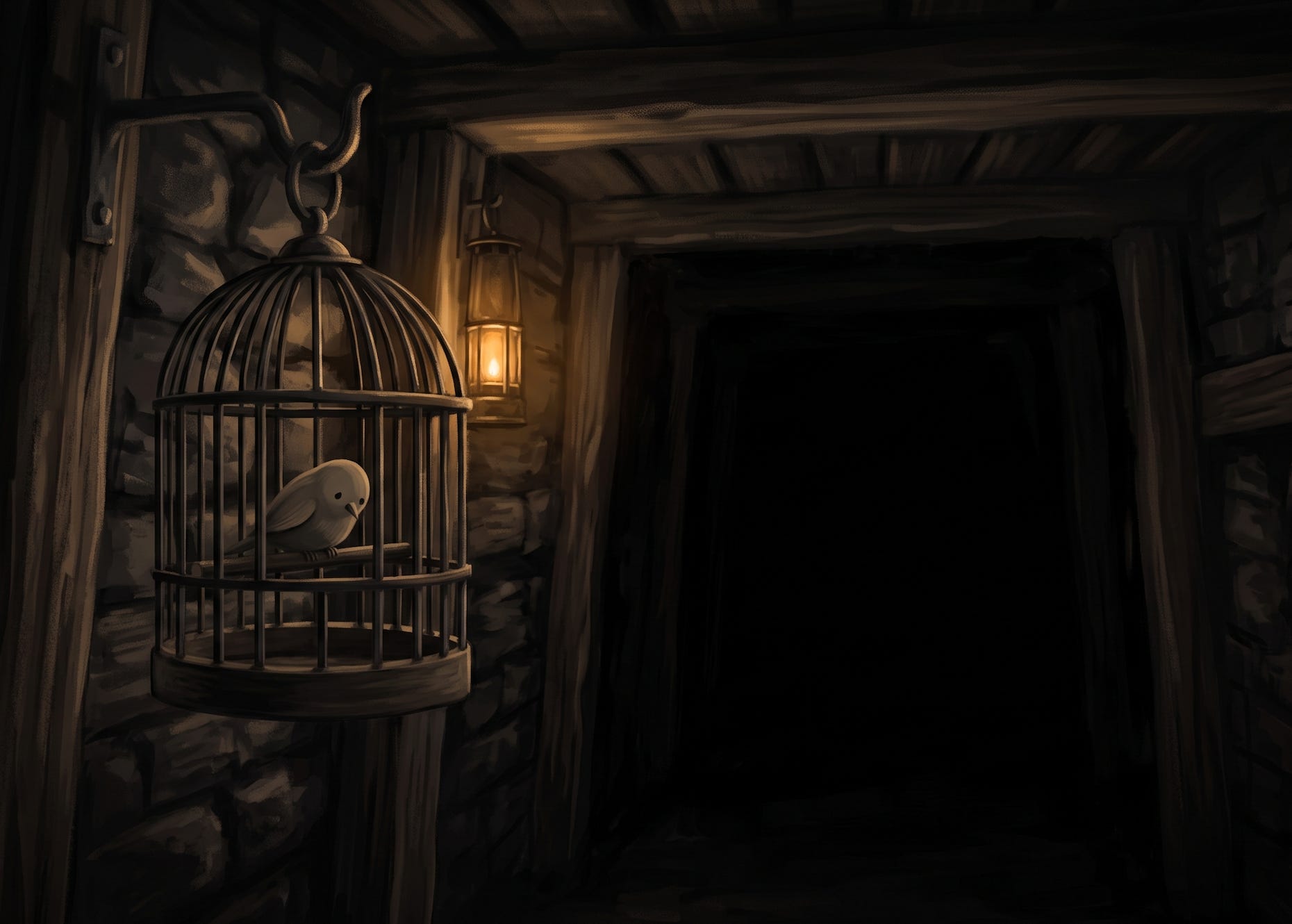
Image by AI tools
There was a kind of danger, underground, that a man could not see or smell or feel, that made no sound and left no mark, and that would kill an entire shift of experienced colliers who had done every other thing correctly.
The gas had names, and the names tell you that people had learned it the hard way. Firedamp, which would take a flame and turn the seam into a furnace, and which at least announced itself when it went, so that the survivors knew what had happened and could tell you afterward. And blackdamp, which did something quieter and worse.
Blackdamp did not burn. That is the first thing to understand about it, and the thing that makes it a different order of problem. It was not a violence waiting for a spark. It was an absence. Oxygen consumed by the slow oxidation of the coal itself, or by timber rotting in the dark, or by the seam simply breathing out over centuries what it had held, and in its place carbon dioxide and nitrogen, gases that do nothing at all. That is precisely the trouble. They do nothing. They have no color to see and no odor to catch and no taste on the tongue and no heat and no motion. They do not attack a man. They merely occupy the space where his air used to be, and stand there, doing nothing, while he breathes them.
And now, let’s move through slowly…..
A man walking into a gallery filling with blackdamp does not feel alarm. He does not gasp. There is no moment of choking that would spin him around and send him running for the shaft. What he feels, first, is that the work is a little harder than it was, and he attributes this, reasonably, to the work, or to his age, or to a poor night’s sleep, or to the fact that it is Thursday and he has been down here since Monday. Then his thinking slows. Not dramatically. It is more that the sharp edges come off it, that the arithmetic of the shift takes a moment longer than it should, that a question asked of him has to be asked twice. And a slowed mind is not equipped to notice that it has slowed, because the instrument doing the noticing is the instrument that has been dulled. Then comes confusion, mild, more like distraction than distress. And then, and this is the word the old accounts use and the word I cannot get out of my head, the man becomes content.
Yes, content. Neither frightened nor fighting. A pleasant heaviness, a sense that everything is basically fine and that there is no particular reason to be standing when one could be sitting. So he sits down. And in the ordinary way of a man taking a moment’s rest in the middle of a long shift, in a gallery that looks exactly like every other gallery he has ever worked, with his lamp still burning and his tools beside him and his mates somewhere down the drift, he does not get up.
I have gone on about this because the shape of it is the whole point, and the shape is this: the danger and the blindness to the danger were the same fact. Blackdamp did not merely kill people. It killed the specific human faculty that would have detected it, and it killed that faculty first, before it killed anything else. It took the alarm before it took the man. There was no moment at which a collier stood in a lethal gallery in full possession of his judgment and made a bad decision. By the time the gas was thick enough to matter, the part of him that would have judged was already gone. That is what made blackdamp patient. That is what made it, for centuries, unbeatable by ordinary vigilance. You cannot ask a man to notice the thing that is eating his noticing.
And the mine gave no help. The rock did not change. The timber held. The gallery a hundred feet away was fine, and this gallery looked exactly like that one, and had looked exactly like it an hour ago when it was fine too. A flame lamp would dim in bad air, which was something, but it was a coarse signal and a late one, and it dimmed for other reasons too, and a man whose judgment had already begun to soften was not the ideal reader of a subtle change in a small flame. Everything a person would ordinarily use to know whether a place was safe returned the answer: safe. Right up until it wasn’t. And by then the returning was being done by a mind that had been quietly emptied of its capacity to disbelieve.
So they carried a bird.
It seems, at this distance, almost tender, and almost absurd, and it was neither. A small caged bird, a canary usually, carried down into the dark by men whose lives were as hard as lives get, not as a companion and not as a mascot but as an instrument. The reason is unsentimental physiology. A bird’s respiratory system is extraordinarily efficient, built for the oxygen demands of flight, moving air through in a one-way circuit rather than in and out of dead-end sacs the way ours does. That efficiency, which is a gift in the open sky, is a liability underground: it means a bird extracts more from every breath, including more of whatever is wrong with the breath. A canary in bad air is affected faster and harder and at lower concentrations than the men standing around it. It is, in the exact sense, more sensitive. And so long before the gas was thick enough to fell a collier, it was thick enough to move the bird.
Now, what did the miners actually watch for? Because “the canary died” is how we tell it now, and it is wrong, and its wrongness matters more than you would think.
A dead bird is a failed warning. A dead bird means you left it too late. The whole value of the instrument was in the range of behavior before death, and the men who used them well were reading a graded scale, not waiting for a binary. They watched the ordinary business of a bird in a cage: the constant small adjustments, the shifting of weight from foot to foot, the head turning, the fussing at the seed, the periodic bursts of song that had no purpose except that the bird was a bird and that is what it did. That was the baseline. That was the sound and the sight of good air, and a man who worked a seam for years had that baseline written into him below the level of thought, the way you know the sound of your own house and only notice it on the night it changes.
The first sign was not death. It was a falling-off of that fuss. The bird went quieter and stiller than a bird ought to be. It stopped the small unnecessary movements. It came off its perch, or it sat low with its feathers puffed in a way that a working collier could distinguish, instantly and without reasoning about it, from the same posture in a bird that was merely sleeping. And most of all, and most usefully, it stopped singing.
That was the warning. Not a dead bird. A quiet one.
And I want to be exact here, because this is the sentence the entire essay is built to carry: the bird did not warn anyone.
The bird did not know it was underground. It did not know there was gas, or men, or danger, or a shift, or a wife at the head of the shaft with a lamp of her own. It had no message and no intention and not the faintest idea that it was, in that moment, the most important living thing for a quarter mile in any direction. It simply lived, in its small way, and answered, in its small body, to the air. When the air turned, it stopped singing. That is all it ever did. It stopped singing.
Everything else, everything we call the warning, was done by a man.
Somewhere in that gallery there had to be a person whose attention was genuinely on that cage. Not near it. On it. A man who had listened to that bird, and to twenty birds before it, through so many hours in so many drifts that the song had become part of the sound of the world down there. And so when it stopped, he heard the stopping. Understand what that requires. To hear a silence you must first have been carrying the sound, continuously, without effort, in the back of your mind, for long enough that its absence arrives as an event rather than as nothing. A stranger in that gallery would have heard no warning at all, because a stranger would have heard only quiet, and quiet is not information unless you were holding the song. Two men standing in the same air, one of them receiving the loudest signal in the pit and the other receiving nothing whatsoever, and the difference between them made entirely of accumulated attention.
And then he had to know what it meant, immediately, in his body rather than in his notes, because a man who has to stop and reason it out is a man whose reasoning is already being taken. He had to know that a quiet bird in that cage was not a resting bird. It was a scream. It was the loudest thing in the pit. And knowing it, he had to do the thing that is easy to say and hard to do, which is to turn his crew and walk them out of a gallery that looked, to every eye and every other instrument, completely fine. He had to act against the evidence of his own senses on the authority of a bird that had merely gone quiet. His men might have grumbled. The seam was good. The shift was not done. And nothing would happen, afterward, to prove him right, because the whole nature of a warning heeded is that the disaster does not occur, and a disaster that does not occur looks exactly like a disaster that was never coming.
That man is the reason the story has survivors. Not the bird. The reading of the bird.
Now I have to lay down the hard part, and I am going to take my time with it, because it does not resolve and I will not pretend it resolves.
Every crew carried a bird. That is the fact that ruins every easy version of this story. It was the rule. The deputy checked it, the regulation named it, the company provided it, and a shift that went down without its cage was a shift in violation. Everyone knew that. So everyone carried the bird. If you had stood at the head of the shaft with a clipboard and asked each crew, as they went down, whether they had their canary, every crew would have said yes, and every crew would have been telling the truth, and your clipboard would have been satisfied identically by all of them.
Let me draw you two of those crews, because they went down the same shaft on the same morning and they are the whole argument.
The first crew had a man in it, call him the one nearest the cage, and the cage was on his hook and it had been on his hook for eleven years. He did not think of himself as doing anything special. If you had asked him what his job was, he would have said he cut coal, and he would have been right, and the bird would not have come up. But the bird’s song was in him the way the smell of the pit was in his clothes, which is to say completely and without his consent and below the level of anything he could have described to you. He knew this particular bird, its habits, that it fussed more in the first hour and settled after, that it went quiet for a moment when the ventilation door swung and then started again. He had a calibration for it that existed nowhere except inside him and that he could not have written down if you had paid him to. When it stopped, he would hear it in the middle of a sentence and stop mid-word.
The second crew also had a bird. The cage was on a hook, and the bird in it was alive and adequately fed and entirely regulation. The man nearest it was not a bad man and not a lazy one; he was a good collier who worked hard and went home to his family. But he was new to that seam, or he had come from a pit where the ventilation was different, or he was simply one of the many people in the world who had never once been told that the carrying and the reading were two different acts. He believed, in the ordinary and completely forgivable way, that the bird was the safety. That having it was the point. That the cage on the hook was a kind of protection in itself, the way a man might feel safer for having a talisman in his pocket. He had never listened to that bird in the sense I mean. He could not have told you, an hour into the shift, whether it was singing or not, because he had never been holding the sound, and so its absence would not arrive as an event. It would arrive as nothing at all.
Now: hold those two crews side by side and tell me what separates them. It is not equipment. Identical. It is not compliance. Both compliant. It is not intention; neither man intended anything but a good shift and a safe one. It is not even competence at the job they were hired to do, which in both cases was excellent. The difference is made of nothing you can photograph, nothing you can file, nothing you can produce for an inspector, nothing that exists anywhere in the world except inside one man’s accumulated attention. It is invisible at the head of the shaft. It is invisible at the coalface. It is invisible for the entire length of every shift on which the air stays good, which is almost all of them.
And it is the only difference that has ever mattered.
I said the story does not resolve, and here is why. There is no test at the top of the shaft that separates those crews. You cannot ask “do you have the bird” because both say yes. You could ask a man to describe the bird’s ordinary behavior and you would learn something, but a clever man can describe a thing he does not attend to, and an inarticulate man may attend perfectly and tell you nothing. The faculty is real and it is decisive and it is nearly unfileable, and any system that tries to check for it will end up checking for the cage, because the cage is what can be checked. This is not a failure of anyone’s diligence. It is a property of the situation, and it is exactly as true above ground, in every industry, in every century, as it was in the pit.
Before I turn this toward the systems I actually keep, there is one more movement, and I think it is the one that will matter most to you, because it forecloses the exit that almost everyone reaches for.
The birds went away. In Britain the last of them came out of the pits in 1986, retired in favor of electronic detectors, and by every honest measure this was progress. The detector is a better instrument than the bird in nearly every respect. It does not need feeding. It does not have moods. It gives a numeric reading rather than a behavior to be interpreted, and it gives it continuously, and it can be calibrated against a known standard, and it will sound an alarm rather than merely going quiet. It is more sensitive, more consistent, and more objective. It is, in short, everything we mean when we say we have solved a problem with technology, and I do not want to be cute about it: the men in those pits were safer afterward. That is not nothing. That is the point of the whole enterprise.
And it did not touch the reading problem. Not at all. Not in the slightest.
Because a detector, too, only changes state. It has no more intention than the canary did. It does not know there is a gallery or a crew or a shift. It converts a property of the air into a number on a display, and there its entire capacity ends, and everything after that, the noticing, the interpreting, the deciding, the turning of the crew and the walking out, is still a human act performed by a person whose attention is actually on the thing. A detector on a belt clip, carried by a man who has never looked at it, is a bird in a cage on a hook. A detector whose alarm has been sounding intermittently for three weeks because of a fault nobody has fixed is worse than a bird, because it has trained the crew to hear the alarm as noise. A detector whose reading nobody understands, whose normal range nobody has internalized, whose drift nobody checks, is a more expensive way of carrying the bird without reading it.
I want to be very clear about what I am claiming, because there is a lazy version of this argument that says technology never helps and that is obviously false. Technology helps enormously. The detector is better than the bird and the men were safer. What I am claiming is narrower and harder: improving the instrument does not reduce the requirement for a reader, and it never has, and there is no version of the instrument that will. Every generation gets a better bird and discovers, usually at cost, that the better bird still needs someone to be watching it. The human half is not a transitional inconvenience awaiting a sufficiently good sensor. It is a permanent structural feature of what it means to be warned by anything at all.
Now I will turn this toward the systems I spend my days inside, and I will try, as always, not to insult you by making your situation smaller than it is.
You have measured your artificial intelligence, or you will. And you already know, if you have been reading these letters, that a number is not safety, because a true and reassuring figure still contains a day. And you know that a certificate speaks in the past tense, because a measurement is a fact about the moment it was taken and the moment it was taken is already gone. Grant all of it. This is the thing standing underneath both of those, the thing they were quietly resting on without saying so.
A measurement is a bird in a cage. It does not warn anyone.
Your dashboard raises no alarm. It displays a value, and the value moves, and that is the whole of what it can do. Your evaluation harness does not tell you that the model has drifted; it produces a score, and the score is lower, and a lower number on a screen is not a warning any more than a quiet bird is a warning. It is a change of state in an instrument. Everything we call the warning, the noticing, the interpreting, the deciding, the going to the people who can act and saying we need to stop, all of that is a human act, and specifically it is an act of reading, and it is performed by a person whose attention is genuinely on the instrument and who has watched it long enough that its ordinary state lives in them below the level of thought. Someone who would catch the change the way you catch a stopped clock in a house gone suddenly too quiet.
And here is the uncomfortable inventory, which I offer without any pleasure, because I have taken it in enough organizations to know how ordinary the answer is.
Most organizations have carried the bird and staffed no one to read it.
They have the dashboard. It exists, it is well-built, and it is open in a browser tab that nobody has looked at in nine days. They have the evaluation, run thoroughly at procurement, by a team that has since moved to another project, against a distribution of inputs that no longer resembles what the system sees on a Tuesday in March. They have the risk register, and it is maintained, and it is maintained for the auditor rather than for the air, which is a distinction invisible on the document and total in its consequences. They have monitoring that alerts, and the alerts go to a channel where they have been firing often enough for long enough that the crew has learned to hear them as noise, which is the worst outcome of all, because it is a detector that has actively trained its readers into deafness. And if you stood at the head of their shaft with a clipboard and asked whether they measure their systems, they would say yes. And they would be telling the truth. And your clipboard would be satisfied.
Go down into the gallery instead and ask a different question. Not do you measure. Ask: who reads it? Who, by name, has that instrument’s ordinary state written into them? Who would notice the change on the day it is small, which is the only day noticing is worth anything? Who has the standing to turn the crew and walk them out of a gallery that looks, to every other eye, completely fine, and who will back them when nothing bad subsequently happens and the whole thing looks in retrospect like an overreaction? Ask that, and the answer, very often, is a silence that is not the good kind.
There is a cage on a hook. There is a bird nobody is watching.
I want to be exact about the human half now, because it is almost always described badly, and the bad description is what makes it so easy to fail while feeling that you are succeeding.
The half of trustworthiness that is not the instrument is not enthusiasm. It is not belief. This distinction is the one I would most like to leave you with, because the industry has spent several years confusing them and the confusion is expensive. An organization can be full of people who are genuinely excited about the technology, who speak warmly about it in every meeting, who have sat through many hours of leadership explaining that this is the future and have come away persuaded, and that organization can be exactly as blind as an organization full of skeptics. Because belief is not literacy. Enthusiasm is not attention. A person who is thrilled about the bird but cannot tell its song from its silence is not reading the bird. He is carrying it, warmly.
And the inverse is just as true and more often missed: the skeptic who watches the gauge every day, who does not much like the technology and does not much trust it and precisely for that reason has its ordinary state written into him, is doing the work. His attitude is irrelevant. His attention is the whole thing. If I had to choose between an organization that believes and does not watch, and one that watches and does not believe, I would take the second one every time, and it is not close.
Nor is this faculty something you can buy or confer. It is not built in a seminar. It is not conveyed by a license, and I say that as someone who holds them. It is not transferred by a policy document, however well written, and I have written some. The capacity to read an instrument is built the only way that capacity has ever been built by anyone in any field, which is by putting your own attention on the actual instrument, repeatedly, over real hours, in real conditions, until you can feel a change before you can name it. There is no shortcut, because the thing being built is not knowledge. It is a baseline, and a baseline is made of exposure and nothing else.
Which brings me to the failure I see most often and have the least patience for, and I want to name it plainly. The senior person who has never watched the gauge himself, who has only ever instructed others to watch it, is carrying the bird by proxy. And carrying by proxy is not reading. He may be entirely sincere. He may have allocated the budget and hired the team and asked for the dashboard and reviewed the summary every month, and every one of those is a real and useful act, and none of them builds the baseline. When the summary says the number moved slightly, he has nothing inside him to compare it against. He cannot feel the wrongness, because feeling the wrongness requires having held the rightness, continuously, in his own attention, and he has never held it. He has held reports about it, which is a different substance entirely. Reading was never a thing you could delegate. It was always a thing you had to have done yourself, in the dark, until it lived in you.
And the last hard piece, which the pit knew and which we relearn every decade at cost: the reader must be able to act. A man who hears the bird stop and has no standing to turn the crew has not saved anyone. He has merely suffered the knowledge. This is where most organizations fail second, having already failed first at building the reader, and it is why the two failures are usually found together. The person with the baseline is junior, because the baseline is built by the people whose hands are actually on the thing, and the person with the authority is senior, because that is what senior means, and between them lies a distance measured in reporting lines and in the small daily discouragements that teach a junior person not to raise things. The gallery fills in that gap. It always has.
So I will not ask whether you measure your systems. You do, or you will, and the number will be good, and the cage will be on the hook, and the clipboard at the head of your shaft will be entirely satisfied. That was never the question. The question is the one the two crews answered differently on the same morning, in the same air, with the same equipment, and answered without knowing they were answering, which is the way this question is always answered:
Your instrument is quiet. Is it quiet because the air is good? Or is it quiet because there is no longer anyone in the gallery who could hear a bird stop singing?
I build the instrument. I build the bird that changes state honestly, that will not flatter the air, that goes quiet exactly when it should and not a moment later. That work is worth doing and I will keep doing it. But an instrument is only ever half of it, and I would rather tell you that than sell you the other half as a whole. A gauge with no one reading it is a bird in a cage on an empty hook, keeping faith with an air that nobody is judging. A reader with no instrument is a collier in the dark with nothing to watch, listening for a song that was never brought down. It takes both.
It always took both.
Suneeta Modekurty