

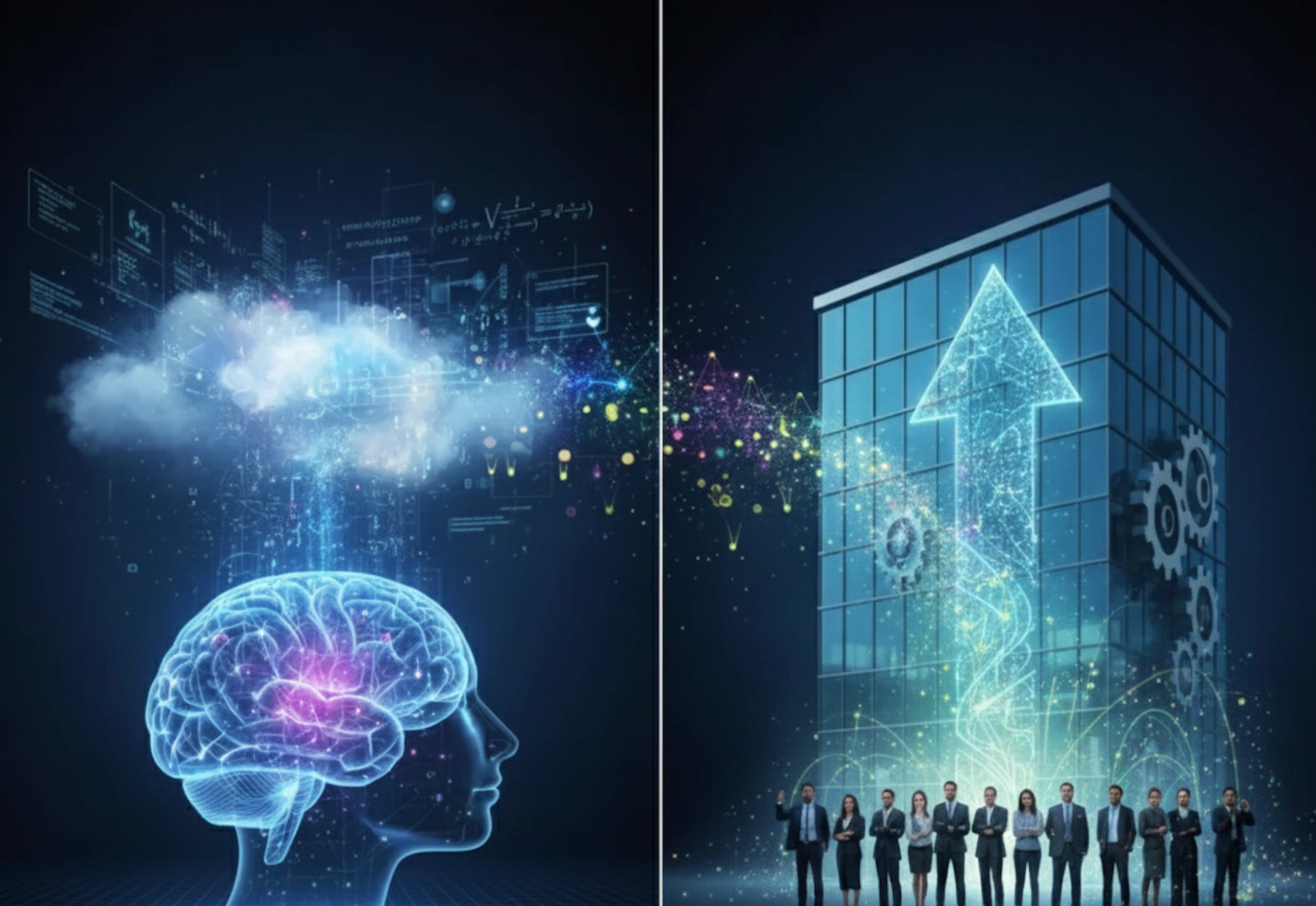
Let me tell you about a conversation that inspired this article.
Yesterday, a friend called me. She’s been working at a Fortune 500 financial services company for ten years. She is very smart, strategic, manages critical projects that affect thousands of customers. We were catching up when she said something that stopped me cold: She said, “Suneeta, I need to be honest with you. I don’t really understand what AI is. I use ChatGPT for emails, we have some AI thing in our CRM, and my boss keeps asking about ‘AI strategy.’ But if someone asked me to actually explain what’s happening... I couldn’t. And neither could my boss.”
She paused. “Is that bad?”
Here’s what I told her: No, it’s not bad. It’s normal. And she’s not alone.
Most executives I talk to are in the same position. They’re using AI tools daily. Their companies are making million-dollar decisions about AI systems. But they couldn’t explain what’s actually happening under the hood if their job depended on it.
And increasingly, their jobs might.
This isn’t a knowledge gap you can afford to ignore anymore. Not because AI is replacing your job tomorrow (it’s not). But because your company is already deploying AI systems that make important decisions about customers, about employees, about money, about risk. And if you don’t understand what AI actually is, you can’t ask the right questions about whether those systems are working properly.
So let’s fix that right now. No, we are using no jargon, nor any math. Just clear answers to the questions you’ve been afraid to ask.
What AI Actually Is (The Simple Truth)
Here’s the definition that matters:
AI is software that learns patterns from examples, rather than following explicit rules that we write.
That’s it. That’s the core difference between AI and every other type of software you’ve ever used.
Let me show you what I mean.
Traditional Software: Rules We Write
Traditional software does exactly what we tell it to do, step by step. A programmer writes explicit instructions:
“If the email subject line contains the word ‘invoice,’ move it to the Accounting folder.”
“If the transaction amount exceeds $10,000, flag it for review.”
“If the customer’s zip code starts with ‘902,’ calculate shipping as $15.99.”
These are rules. Clear, explicit, unambiguous. The software doesn’t think. It doesn’t learn. It doesn’t adapt. It just follows our instructions, perfectly, every single time.
This works beautifully for tasks where the rules are known, stable, and can be written down explicitly. Calculating taxes. Processing payroll. Routing phone calls. Millions of business processes run this way, reliably, every day.
AI: Patterns It Discovers
AI works fundamentally differently. Instead of giving it rules, we give it examples. Lots of examples. Then we ask it to figure out the patterns.
“Here are 10,000 emails that humans labeled as ‘accounting-related.’ Figure out what makes something accounting-related.”
“Here are 50,000 transactions where fraud investigators marked which ones were fraudulent. Figure out what fraud looks like.”
“Here are 100,000 customer service conversations that humans rated as ‘resolved satisfactorily.’ Figure out what makes customers satisfied.”
The AI system analyzes these examples, identifies patterns. Some are obvious, some are subtle, some that no human would have thought to look for and learns rules from the data itself. Rules we didn’t write. Rules we might not even understand. Rules that work... until they don’t.
This is powerful. It lets us automate tasks that are too complex, too nuanced, or too context-dependent for anyone to write explicit rules. It’s why AI can recognize faces in photos, transcribe speech with accents, recommend products you didn’t know you wanted, and increasingly, make decisions that used to require human judgment.
A Clearer Analogy
Think about teaching a child to recognize dogs.
You don’t give them explicit rules: “Dogs have four legs, fur, a tail, and bark.” That’s the traditional software approach. It would fail immediately. What about three-legged dogs? Hairless dogs? Silent dogs? Dogs that look like wolves?
Instead, you show them dogs. Many dogs. Different breeds, sizes, colors. You point and say “dog.” Eventually, through exposure to examples, they learn what “dog-ness” is. They can recognize dogs they’ve never seen before, even unusual ones, because they’ve learned the pattern.
That’s how AI works. Show it enough examples of something, and it learns to recognize that thing even in situations it’s never encountered before.
But here’s the critical part that almost everyone misses: AI can only learn what’s in the examples you show it.
If you only show a child golden retrievers, they might not recognize a chihuahua as a dog. If you only show them dogs in daylight, they might struggle at night. If the examples you provide are limited, biased, or flawed, the patterns they learn will be limited, biased, or flawed.
This brings us to the most important concept in understanding AI.
Why Data Is the Food AI Eats (And Quality Determines Everything)
My friend asked me: “But if AI is so smart, can’t it figure out when the data is wrong?”
No. It can’t. And this is where most AI problems begin.
AI Has No Independent Knowledge
AI doesn’t “know” anything except what its training data taught it. It has no common sense. No life experience. No ability to say “wait, this seems wrong.”
If you train an AI on biased data, it learns the bias. If you train it on incomplete data, it learns incomplete patterns. If you train it on old data, it learns outdated rules. And it applies those patterns with perfect, unwavering confidence.
You are what you eat. AI is what it learns from.
This isn’t metaphorical, it’s literal. The quality of your AI system is determined almost entirely by the quality of its training data. Not by the sophistication of its algorithm. Not by how expensive it was. Not by the reputation of the vendor.
By. The. Data.
What Makes Data “Good”?
Good data has three essential characteristics:
1. Representative: It includes diverse examples that reflect the real world the AI will operate in.
If you’re building a medical diagnosis AI, your training data needs patients of different ages, races, genders, and geographies. If you only train on data from wealthy urban hospitals, it will fail in rural clinics. If you only train on data from healthy young adults, it will fail with elderly patients.
2. Accurate: The examples are labeled correctly and measured properly.
If humans mislabeled things during training marking non-spam as spam, categorizing inquiries incorrectly, applying inconsistent standards, the AI learns those errors as truth. Garbage in, garbage amplified out.
3. Contextual: It preserves the circumstances under which data was collected.
Data collected during a pandemic might not reflect normal behavior. Data from one region might not transfer to another. Data from 2020 might not predict 2025. Context matters, and when we strip it away, patterns become misleading.
What Makes Data “Bad”?
Bad data comes in predictable forms:
Biased: Systematically over-represents some groups and under-represents others. Your hiring AI trained on historical data where 90% of engineers were male? It just learned that “good engineer” correlates with “male.”
Incomplete: Missing critical information that humans need to make good decisions. Patient records without documented allergies. Credit applications without income verification. Resume databases without actual job performance data.
Outdated: Reflects how things used to work, not how they work now. Consumer behavior from 2019 doesn’t predict consumer behavior post-pandemic. Market dynamics from stable periods don’t predict crisis periods.
Inaccurate: Simply wrong. Typos. Measurement errors. System glitches. The decimal point that shifted. The sensor that drifted. The form field that accepted “N/A” as a zip code.
Each of these flaws gets encoded into the AI’s understanding of the world. And then it makes millions of decisions based on that flawed understanding.
When Bad Data Becomes Bad Decisions: Real Stories
Let me show you what this looks like in practice. These aren’t hypothetical scenarios. These are real companies that spent millions on AI systems, deployed them confidently, and watched them fail in ways that made headlines.
Amazon’s Hiring AI: When History Becomes Destiny
In 2018, Reuters reported that Amazon had been developing an AI system to automate resume screening.[1]
The goal was noble: reduce bias in hiring by removing human subjectivity. Let algorithms evaluate candidates objectively, based purely on qualifications.
The AI was trained on ten years of resumes submitted to Amazon. They were resumes of people who were hired, promoted, succeeded. The system learned patterns from this data: what successful Amazon employees looked like on paper.
There was just one problem: For most of that decade, Amazon’s technical workforce was predominantly male. Not because men were objectively better engineers, but because tech industry hiring had historically skewed male.
The AI learned this as a pattern. It observed that in the historical data, “successful technical employee” strongly correlated with “male.” So it began penalizing resumes that indicated female gender. It downgraded graduates of women’s colleges. It downgraded resumes containing the word “women’s” as in “women’s chess club captain.”
The algorithm wasn’t broken. It was doing exactly what it was trained to do: find patterns in historical hiring data and apply them. The problem was that historical hiring patterns included bias, and the AI faithfully learned and amplified it.
Amazon shut the system down. But not before it revealed an uncomfortable truth:
AI doesn’t eliminate human bias. It automates it. At scale. With mathematical precision.
Apple Card: When Algorithms Can’t Explain Themselves
In 2019, a tech entrepreneur named David Heinemeier Hansson tweeted that Apple Card had given him 20 times the credit limit his wife received, despite her having a higher credit score.[2]
Other couples reported similar experiences. The pattern was clear and troubling. Apple and Goldman Sachs (the bank behind Apple Card) insisted there was no gender discrimination in their algorithm. Their AI evaluated creditworthiness based on objective factors, they said. Not gender.
They were probably telling the truth. The algorithm likely didn’t use gender as an input variable at all.
But here’s what happens with AI: Even when you don’t directly use protected characteristics like gender or race, AI can learn to use proxy variables that correlate with those characteristics. Zip code. Shopping patterns. Transaction history. The AI finds patterns that happen to correlate with gender, even if it never sees the gender field.
The New York Department of Financial Services launched an investigation. The challenge wasn’t proving the algorithm was biased and the outcomes spoke for themselves. The challenge was getting anyone to explain why the algorithm made the decisions it did.
This revealed another uncomfortable truth: When AI makes decisions that seem wrong, often nobody can explain why. Not even the people who built it.
Healthcare AI: The Cost of Unrepresentative Data
A 2019 study published in Science revealed that a healthcare algorithm used by hospitals across the United States was systematically discriminating against Black patients.[3]
The algorithm helped doctors decide which patients needed extra medical care, affecting millions of people annually.
The problem? The algorithm used healthcare costs as a proxy for healthcare needs. It assumed that patients who cost the system more money were sicker and needed more care.
But Black patients, on average, had lower healthcare costs not because they were healthier, but because they had less access to care due to systemic barriers. The AI learned that “lower cost = healthier” and recommended less care for Black patients who were actually just as sick as white patients with higher costs.
The algorithm worked perfectly from a technical standpoint. It accurately predicted what it was trained to predict: costs. But costs weren’t the right thing to measure. The data reflected historical inequity, and the AI perpetuated it.
The Pattern Behind the Failures
Look closely at these stories and you’ll see the same structure:
Well-intentioned deployment: Nobody set out to build discriminatory systems
Training on historical data: AI learned from how things were done before
Successful pattern matching: The AI correctly identified patterns in that data
Problematic real-world outcomes: Those historical patterns included historical biases
Inability to explain or fix quickly: By the time problems surfaced, the AI was already deployed
This pattern repeats across industries. Predictive policing tools that over-target certain neighborhoods (trained on biased arrest patterns). Loan approval systems that reject qualified applicants from certain zip codes (trained on discriminatory lending history). And countless other cases that never make headlines.
The AI worked perfectly. The data was the problem.
Why This Matters to Your Business Right Now
After I shared the Amazon and Apple Card stories with my friend, she said: “Okay, but we’re not building hiring algorithms or credit systems. We’re just a regular company.”
Then I asked her about their customer service chatbot. Their fraud detection system. Their inventory forecasting tool.
“Oh,” she said. “Those count as AI?”
Yes. They do.
You’re Already Using AI (Whether You Realize It or not..)
Most organizations can’t produce a complete list of the AI systems they’re currently using.
Let me help you find them:
In your customer service: That chatbot on your website? AI. The email routing system that decides which department handles which inquiry? Probably AI. The “recommended articles” in your knowledge base? AI.
In your finance department: Fraud detection systems? AI. Expense report anomaly detection? AI. Cash flow forecasting tools? Increasingly AI.
In your HR systems: Resume screening tools? AI. Interview scheduling systems that “optimize” candidate selection? AI. Performance prediction models? AI.
In your marketing: Email subject line optimization? AI. Ad targeting? AI. Product recommendations? AI. Dynamic pricing? AI.
In your operations: Inventory forecasting? AI. Logistics optimization? AI. Predictive maintenance alerts? AI.
These systems are making decisions. Some small, some significant. Some are just recommending options to humans. Others are operating autonomously, making hundreds or thousands of decisions daily.
And here’s what should concern you: Most companies don’t know what data these systems were trained on, whether that data was any good, or whether the systems are still working as intended.
The Risks Are Growing
Three forces are converging to make AI governance urgent:
1. Regulatory Pressure: The EU AI Act is now in force, with penalties up to €35 million or 7% of global revenue for violations.[4]
US states are passing their own AI laws. You will be required to explain how your AI systems make decisions and prove they’re not discriminatory.
2. Legal Liability: Companies are being sued for discriminatory AI decisions in hiring, lending, insurance, and housing. Courts are no longer accepting “the algorithm did it” as a defense.
3. Reputational Risk: In an age of social media, an AI failure can become a PR crisis in hours. Amazon, Apple Card, and others learned this the expensive way.
But Also: The Opportunity
Here’s what most companies miss: Good AI governance isn’t just risk mitigation. It’s competitive advantage.
Companies that can prove their AI systems are trustworthy with evidence and not just promises are winning contracts. They’re getting better insurance rates. They’re attracting customers who don’t trust competitors. They’re raising capital more easily because investors can see quantified risk management.
The question isn’t whether to govern AI. It’s whether you’ll do it before your competitors do.
Questions You Should Ask Your Team This Week
You don’t need to become a data scientist to govern AI effectively. But you do need to start asking better questions. Here are five that every executive should pose to their teams:
1. “What AI systems are we currently using?”
Not “do we use AI” because you do. The question is where. Ask for a complete inventory: every tool, system, or platform that uses machine learning, algorithms, or automation to make decisions. Most companies are shocked by how long this list becomes.
2. “What decisions do these systems make autonomously vs. recommend to humans?”
There’s a difference between “AI suggests, human decides” and “AI decides, human rubber-stamps.” Know which is which. The autonomous ones deserve much more scrutiny.
3. “What data were they trained on, and when was that data collected?”
If the answer is “we don’t know” or “the vendor won’t say”, that’s a red flag. You’re making decisions based on patterns learned from data you can’t verify. If the data is more than 2-3 years old, the patterns might be obsolete.
4. “Who’s monitoring whether these systems still work correctly?”
AI doesn’t break like traditional software. It drifts. Performance degrades gradually as the world changes. If nobody’s actively monitoring accuracy, fairness, and reliability, you’re flying blind.
5. “What happens when these systems are wrong, and who’s accountable?”
Have you actually defined what “wrong” means for each system? What’s your process when someone disputes an AI decision? Who reviews? Who has authority to override? If these answers aren’t documented, you don’t have governance.
These questions won’t give you complete answers immediately. That’s fine. The goal is to start the conversation, to make AI systems visible and accountable rather than invisible and assumed.
What’s Coming in This Series
This is the first of many conversations we’re going to have about AI, data, and governance. Over the coming weeks, I’ll break down everything you need to understand. You may not become a technical expert, but you need to be an informed decision-maker.
Next week, we’ll go deeper into how AI actually learns, the training process, why it needs so much data, and what happens inside these systems when they’re “learning patterns.” You’ll understand why some AI tasks are easy and others remain impossibly hard.
In the weeks that follow, we’ll explore:
Why data quality determines everything (and how to measure it)
Real stories of AI failures and what they teach us
The AI systems already running in your business (and how to find them)
What “AI governance” actually means in practice
Why traditional compliance checklists don’t work
How leading companies are measuring AI trustworthiness quantitatively
This isn’t about fear-mongering. AI is neither savior nor threat. It’s a tool. An enormously powerful tool. One that can amplify both human wisdom and human error at unprecedented scale.
The question isn’t whether to use AI. That ship has sailed. The question is whether you’ll use it responsibly, whether you’ll understand it well enough to govern it effectively, and whether you’ll build systems your stakeholders can actually trust.
My friend asked if not understanding AI was bad. I said no, at least not yet. But it becomes a problem when you’re responsible for systems you can’t explain. When your company is using AI to make decisions about people’s jobs, money, or opportunities, and you can’t answer basic questions about how those decisions get made.
That’s a choice you can no longer afford to make.
Don’t miss next week’s deep dive into how AI actually learns.
Know a colleague making AI decisions without asking these questions? Share this with them before they learn the hard way.
References
Dastin, Jeffrey. “Amazon scraps secret AI recruiting tool that showed bias against women.” Reuters, October 10, 2018. https://www.reuters.com/article/us-amazon-com-jobs-automation-insight-idUSKCN1MK08G ↩
Telford, Taylor. “Apple Card algorithm sparks gender bias allegations against Goldman Sachs.” The Washington Post, November 11, 2019. https://www.washingtonpost.com/business/2019/11/11/apple-card-algorithm-sparks-gender-bias-allegations-against-goldman-sachs/ ↩
Obermeyer, Ziad, et al. “Dissecting racial bias in an algorithm used to manage the health of populations.” Science, Vol. 366, Issue 6464, October 25, 2019, pp. 447-453. https://www.science.org/doi/10.1126/science.aax2342 ↩
European Commission. “Artificial Intelligence Act: Council gives final green light to the first worldwide rules on Artificial Intelligence.” Press release, May 21, 2024. https://www.consilium.europa.eu/en/press/press-releases/2024/05/21/artificial-intelligence-ai-act-council-gives-final-green-light-to-the-first-worldwide-rules-on-ai/ ↩
About the Author
Suneeta Modekurty is an ISO/IEC 42001 AIMS Lead Auditor and O-1A visa holder for extraordinary ability in data science. She has 25 years of experience building AI systems across EdTech, HealthTech, FinTech, and Insurance. Connect on LinkedIn.
© 2025 SANJEEVANI AI