

Image created using AI tools
When a company lays off nearly a quarter of its staff, the narrative is usually one of retreat. But ClickUp’s recent 22 percent headcount cut was different. It was an aggressive, forward-leaning restructuring designed to answer a single, brutal question: Who deserves to survive in the age of AI?
The people who stayed, the survivors, were not kept because they knew how to write basic prompts or use chat interfaces. They were kept because they possessed a capability that most organizations cannot even define, let alone measure: the ability to direct, audit, and take absolute operational accountability for machine output.
This represents a massive, necessary transition from AI Literacy to AI Readiness.
Most executives treat AI adoption as a soft skill, rolling out licenses and calling “basic prompting” a success metric. But this approach creates a black box. When you cannot measure what your AI tools are actually producing, you cannot enforce accountability. You end up with an unmanageable explosion of automated noise. ClickUp’s restructure is the first industrial-scale proof that AI adoption without structural measurability is a dead end. It is a loud wake-up call for how we define the work of the future.
The Myth of Universal Productivity
In May 2026, ClickUp, a software company valued at $4 billion, announced a 22 percent headcount reduction. But unlike the standard tech layoffs of the past few years, which were framed as defensive, cost-cutting measures, ClickUp’s CEO, Zeb Evans, framed this cut as a proactive, structural bet.
Evans wrote on X that “the business is the strongest it’s ever been” and that “this wasn’t about cutting costs.” The goal was to completely rebuild the company around what he calls a “100x organization.”
To incentivize the transition, ClickUp threw traditional compensation structures out the window, introducing $1 million cash salary bands for the employees who remained, provided they could demonstrate “100x impact” by building and managing AI systems.
The mainstream headline was the layoff. The real story is the structural thesis underneath.
Evans challenged one of the most sacred assumptions of the generative AI era: the idea that AI tools automatically make everyone more productive. He argued the exact opposite.
In a traditional workflow, giving AI tools to junior or untrained staff does not speed up an organization. It creates an explosion of raw volume. Evans pointed specifically to companies celebrating 500 percent increases in pull request volume without matching customer outcomes, calling this “the great reckoning of AI coding.”
But someone has to review that output. Someone has to fix the subtle, confident errors the AI made. When that mass of automated volume collides with senior staff, it creates a massive review bottleneck. The senior people end up spending all their time auditing, rewriting, and debugging AI-generated noise.
As Evans bluntly wrote: “AI makes the best engineers wildly more productive, and everyone else using AI slows these engineers down... More code is just another bottleneck.”
This is the great paradox of the agentic era. When the cost of generating work drops to zero, the cost of evaluating that work becomes the most expensive line item in your business.
And that is where the line between AI literacy and AI readiness is drawn.
AI Literacy vs. AI Readiness
Most corporate training programs are designed to build AI Literacy. They teach employees what a Large Language Model is, how to open a chat interface, and how to write basic prompts. It is cognitive, basic, and tool-centric.
AI Readiness, however, is operational. It is the human capability to direct, judge, and take absolute accountability for automated systems.
When a company runs thousands of AI agents internally, it doesn’t need people who can write. It needs people who can manage. It needs what ClickUp calls Agent Managers: workers who can automate their own manual tasks, build systems around those automations, and act as the rigorous human filter for the machine’s output.
To build an organization of Agent Managers, companies must cultivate three distinct human capabilities.
1. Direction: From Prompting to Orchestration
An AI tool does exactly what you tell it to do. Therefore, the harder and more nuanced the work, the more critical the telling becomes.
The AI-Literate worker prompts: “Write a marketing email for our consulting services.” The result is a generic, instantly deleted block of corporate jargon.
The AI-Ready worker orchestrates: “Write a 200-word email to a small business owner who has heard of AI but fundamentally distrusts it. Open by directly validating that trust barrier, and close with a single, low-friction question they can answer in 30 seconds.”
The core skill here is not writing. The skill is system design. It is the ability to deconstruct a highly complex, intuitive human process, isolate its underlying variables, and translate them into a structured instruction set that an agent can execute flawlessly.
For decades, corporate structures have rewarded people for doing the work. Suddenly, we need people who can describe the work in such vivid, mechanical detail that a machine can replicate it. That is a rare, highly strategic skill. Traditional prompt-engineering workshops do not teach it because it requires deep domain expertise, not just software knowledge.
2. Judgment: The Review Bottleneck
Because AI tools produce highly confident, plausible-sounding answers that are frequently wrong, the ultimate bottleneck is no longer production. It is review.
The readiness skill here is knowing when to trust the output and when to interrogate it. This skill cannot be installed via a corporate slide deck. It is the slow, painful result of having done the manual work yourself, badly, for years.
It is what a senior software architect brings to reviewing AI-generated code, or what a veteran forensic accountant brings to an AI-run reconciliation. They do not look at the 99% that is right. They have the instinct to find the 1% that is catastrophically wrong.
Companies that lay off their expensive, senior experts while keeping only their cheap, “AI-fluent” juniors are going to discover their lack of judgment the hard way.
They will find themselves drowning in flawless-looking, broken work.
AI literacy lets you generate the code. AI readiness gives you the wisdom to realize that code should never go to production.
3. Ownership: The Air Canada Rule
An AI agent does not get fired when a calculation is wrong, and it does not get sued when a client is misled. The human in the chair does.
This is the psychological side of AI readiness that never makes it into vendor product demos. It is the willingness to sign your name to output you did not write, defend it to a client when it is challenged, and accept the professional and legal consequences when it fails.
This isn’t theoretical. In February 2024, the British Columbia Civil Resolution Tribunal ruled in Moffatt v. Air Canada that the airline was liable when its customer-facing chatbot promised a passenger an unauthorized bereavement refund. In its defense, the airline argued that the chatbot was a “separate legal entity” responsible for its own misinformation. The tribunal rejected the argument outright, ruling that the company was entirely accountable for the systems it chose to deploy.
Somebody at Air Canada owned that mistake, whether they wanted to or not.
Most companies have still not defined who legally and operationally owns their AI’s output. They will figure it out the first time a customer pushes back, and the lesson will be incredibly expensive.
The New Architecture of Work
If ClickUp’s thesis is correct, the transition to AI readiness will force a radical redesign of traditional corporate roles. Evans has outlined three distinct classes of ready workers:
The Builders. These are the 10x engineers and product designers. They are no longer typing lines of code or drawing static mockups. They are acting as system architects, directing fleets of agents to build, test, and iterate. They spend their time on system design and validation.
The Agent Managers (Systems Managers). These are operational workers who have successfully automated their own manual tasks. Instead of being displaced, they are kept because they possess the institutional knowledge required to run, monitor, and troubleshoot the automated systems they created. As Evans put it: “The people that automate their jobs with AI will always have a job.”
The Front-liners. These are the human-to-human connection points. In an era where AI can generate infinite digital noise, authentic human contact becomes a premium bottleneck. Under ClickUp’s model, customer-facing humans are explicitly protected from automation. They do not use AI to replace meetings. They use AI to automate everything around the meetings, so they can spend 100% of their time focused on real human relationship-building.
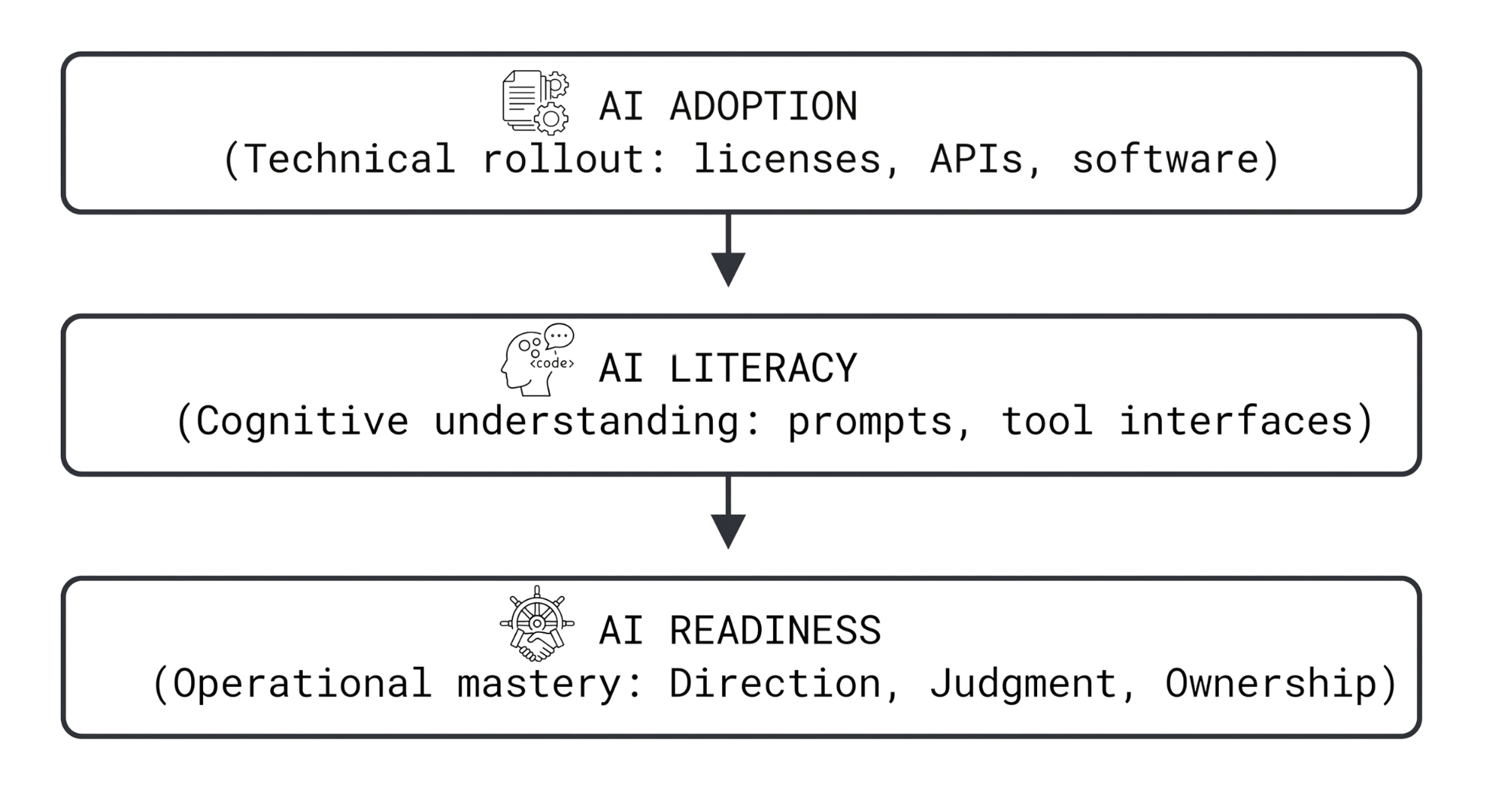
Image created with AI tools
Why Readiness Cannot Be Bought
The pattern repeating across the corporate world is a fundamental confusion of terms.
AI Adoption is technical. It is the work of installing software, integrating APIs, and provisioning licenses. Adoption can be bought. You sign a contract, run a launch event, and the software lands on every laptop in the company.
AI Literacy is cognitive. It is the basic understanding of how these tools work. Literacy can be taught via quick workshops and video modules.
AI Readiness is operational. It is the human capability to establish direction, exercise judgment, and accept ownership over automated workflows. Readiness cannot be bought, and it cannot be taught in a 45-minute webinar. It must be built through deliberate, supervised practice on real-world work over months.
This is why so many pilot programs yield zero measurable ROI. They successfully bought adoption, achieved basic literacy, and completely skipped readiness.
What to Do This Week
If you want to know where your company actually stands on the spectrum of AI readiness, run this simple test on Monday morning.
Pick one AI tool your team currently uses. Select one piece of work that tool produced this week.
Then ask these three questions.
Direction. Who wrote the operational instructions that produced this output, and could a different colleague reproduce this exact quality using those instructions alone?
Judgment. Who audited this specific output, and exactly how do they know it is correct?
Ownership. If this output goes to a client and severely backfires, whose name is on the line?
If you cannot confidently answer all three questions for a single piece of work, your company has adopted a tool, but it has not built readiness. You have active software, but you do not have an active system.
Closing that gap is the defining corporate challenge of the next two years. The organizations that build true AI readiness will look unrecognizable from the inside by the end of the decade. The ones that do not will still be running prompt-writing workshops, staring at empty dashboards, wondering where their ROI went.
Sources
Zeb Evans, post on X (May 21, 2026). primary source for the 22% layoff, the “100x organization” framing, and Evans’s direct quotes.
Fortune, “Outnumbered: At $4 billion ClickUp, a 3:1 agent-to-human ratio is rewiring work itself” (May 18, 2026). source for the 3,000 internal AI agents and the 3:1 agent-to-employee ratio.
StartupHub.ai, “ClickUp’s 22% cut comes with $1M salary bands. Evans calls it the 100x org.”. source for Evans’s “great reckoning of AI coding” critique and the 500% pull request volume reference.
The Next Web, “ClickUp cuts 22% of staff, offers $1M salaries in AI restructuring”. source for the Builders / Agent Managers / Front-liners taxonomy.
Business Today, “’People who automate jobs with AI will always have a job’: ClickUp cuts 22% of its workforce”. source for the Agent Manager quote.
Moffatt v. Air Canada, British Columbia Civil Resolution Tribunal (February 14, 2024). source for the Air Canada chatbot liability ruling.
Suneeta Modekurty | Founder, SANJEEVANI AI | Quantifying AI Readiness